
Can the Space Station Be Seen Tonight? How to Tell
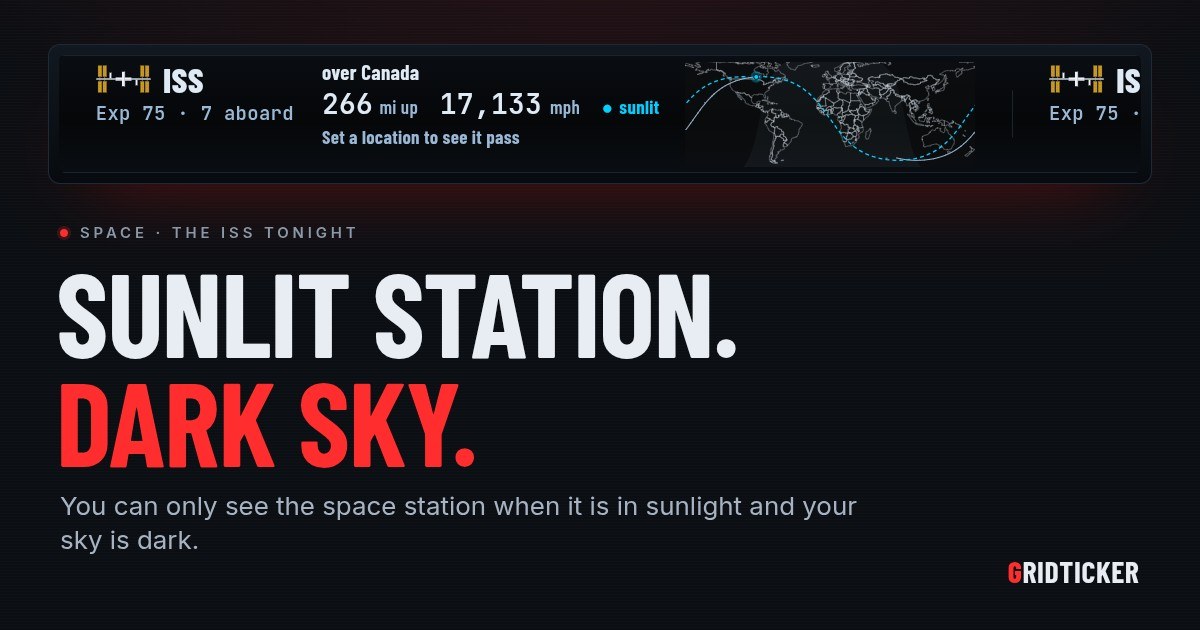
Can the space station be seen tonight? It depends on where you are. Three things have to happen at once: the station has to be in sunlight, your sky has to be dark, and its path has to cross your sky high enough to clear the trees and rooftops. That means a visible pass only happens in the hour or two after sunset or the hour or two before sunrise. The passes also come in runs, with stretches of a week or two when your place gets none at all. So on any given night the answer is yes for some people and no for others. The only way to know is to check the passes for your own location. The rest of this article explains why, so you can tell a pass worth going outside for from one that isn't.
Why you can only see it at dusk and dawn
The International Space Station makes no light of its own. What you see is sunlight bouncing off its solar arrays and modules. For that to reach your eyes, two things have to be true at the same moment:
- The station is in sunlight. It orbits a few hundred miles up, so it can still be in sunshine after the Sun has set where you stand.
- Your sky is dark. Against a daytime sky, even a bright reflection doesn't show.
Both are only true near twilight. Shortly after sunset the ground has gone dark but the station, high above, still catches the Sun. Shortly before sunrise the same thing happens in reverse. In the middle of the night the station is usually in Earth's shadow and can't be seen, even when it passes straight overhead.
This is also why a pass can end before the station reaches the horizon. It can fade out in the middle of the sky as it moves into Earth's shadow.
Why some weeks have no passes at all
The station's orbit doesn't line up with your twilight every day. For a stretch of days its path crosses your sky in the evening or the morning while it's sunlit. Then the timing drifts and the passes fall in daylight or in the dark part of the night, where you can't see them. The visible passes come back after a week or two.
So if you looked last week and found nothing, that doesn't tell you much about tonight. And a good pass a few days ago doesn't promise another one this evening.
Not every pass is worth going outside for
Even within a run, passes differ a lot. Some cross high overhead, and some barely lift above the horizon.
How high is high enough
A pass is described by its highest point, in degrees above the horizon. The horizon is 0 and straight up is 90. As a rough guide:
- About 10 degrees: low. Trees, buildings and haze near the horizon often hide it.
- About 20 degrees: clears most trees in an ordinary yard.
- About 30 degrees: a third of the way up the sky, easy to spot.
- 40 degrees and up: a high pass. These are the ones to plan an evening around.
A fist held at arm's length covers roughly 10 degrees, so a 30-degree pass tops out about three fists above the horizon.
Clouds and city light
A good pass is no use under a cloudy sky. Check the forecast for the minutes of the pass, not for the evening in general. City light matters less than you might think, because the station is bright enough to show from most backyards. Still, a clear view in the right direction helps more than anything else.
What a pass looks like
If you've never seen one, here is what to expect:
- A steady point of light, with no blinking. Blinking lights are an airplane.
- It moves smoothly and fairly quickly, crossing a large part of the sky in a few minutes.
- It rises from one side of the sky and sets on the other. Or it can fade out partway across as it enters Earth's shadow.
You don't need binoculars or a telescope. Just know which way to face and how high to look, and be outside a couple of minutes early.
There is a second station: Tiangong
The ISS isn't the only crewed station up there. China's Tiangong follows the same rules: it can be seen only when it is sunlit and your sky is dark. It is smaller than the ISS, so it's a fainter target. But its passes come at different times, so a night with no ISS pass may still have a Tiangong pass.
A quick checklist for tonight
- Look up the passes for your exact location. A pass for a city a few hundred miles away can be very different from yours.
- Check that the pass falls after sunset or before sunrise.
- Check its highest point. Aim for 20 degrees or more if you have trees around you.
- Note which direction it appears from.
- Check the cloud forecast for that time.
- Go out a few minutes early and let your eyes adjust.
If you want to know where the station is at this moment, or how its path across the map works, see Where Is the ISS Now? How to Read Its Ground Track and Space Station Location Tonight: When and Where to Look.
How GridTicker answers the question for you
GridTicker is a live ticker that runs in any browser, on a spare screen, a second monitor or a TV. Its Space section can carry both stations, the ISS and China's Tiangong. Each one is its own feed under Space feeds, and you choose which screens it appears on. The ISS card shows what the station is over right now, how high and how fast it is going, whether it is in sunlight, and who is aboard. The bottom line of the card gives the next time it can be seen from your place.
You set your place on the Space page. Type an airport code or use your browser's location. If you leave it blank, GridTicker uses your Flights location, and failing that, your first weather place.
You can also decide which passes count. Passes that climb at least is set to 10, 20, 30 or 40 degrees, so low passes behind your trees can be left out. The guide's section on the space stations explains the setting.
When a pass is coming, the screen tells you. Five minutes before, it shows a countdown and which way to face. While the station is up, it draws your sky as a circle, with the horizon at the edge and straight up in the middle. The station is shown where it is now, with how high to look in degrees and in fists held at arm's length. Each alert can be switched off on its own, and none of them shows on a screen a schedule has turned off.
To have the next pass waiting on your screen, set up a strip at https://app.gridticker.com/signup. Every new account starts with a trial.