
Space Station Location Tonight: When and Where to Look
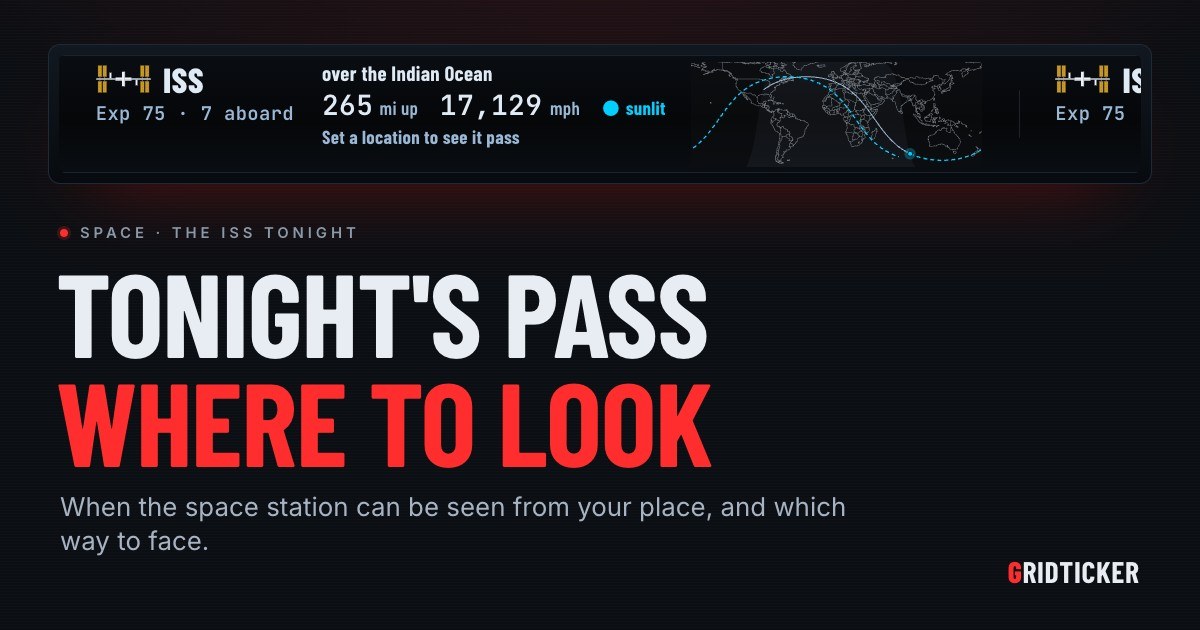
The space station's location tonight changes every minute, because it goes around the Earth about every hour and a half. So when you look up the space station's location tonight, the more useful question is whether it will pass over you after dark, and where to look. You can only see the station while it is in sunlight and your sky is dark. That usually means an hour or two after sunset or an hour or two before sunrise. Visible passes come in runs, with a week or two between runs. If tonight falls inside a run, the station shows up as a bright, steady point that crosses the sky in a few minutes. If it doesn't, the next run is coming.
If you want to see where the station is right this second, we cover that in Where Is the ISS Right Now?. This article is about going outside tonight and finding it.
Why "tonight" is the question that matters
The station is always somewhere. It crosses oceans, deserts and cities around the clock, and you can find its position on a map any time. Most of those positions do you no good from your backyard. When it is overhead in the middle of the day, the sky is too bright to see it. When it is overhead in the middle of the night, it is in the Earth's shadow and nothing lights it up.
What you need is the short stretch when the station is high enough over your horizon, still lit by the sun, and crossing a sky that has already gone dark where you stand. That happens near dusk and dawn, which is why a search for its location tonight is really a search for its next pass.
When the space station can be seen
Sunlight and a dark sky
The station gives off no light you can see from the ground. It shines because it reflects sunlight. Right after sunset you are in darkness, but the station, about 250 miles up, is still in full sun. That gap gives you the window. As the night goes on, the station moves into the Earth's shadow too, and evening passes stop. The same thing happens in reverse before dawn.
Passes come in runs
The station's path shifts a little on every orbit. For a week or two, its evening or morning passes line up with dark skies where you live, and you may get a pass on several nights in a row, sometimes two in one night. Then the timing moves into daylight or the middle of the night, and nothing is visible for a while. A night with no pass doesn't mean you missed it for good. It means you are between runs.
How to read a pass
A pass has three parts:
- Where it appears. The direction to face, given as a compass direction. The station rises from near the horizon.
- How high it climbs. Measured in degrees: the horizon is 0 and the point straight overhead is 90.
- Where it goes. It crosses part of the sky, then sets toward the horizon or fades out as it enters the Earth's shadow.
To judge degrees, hold your fist out at arm's length. One fist covers roughly ten degrees, so a pass that peaks at 40 degrees is about four fists above the horizon.
Which passes are worth going out for
Height matters more than anything else. A low pass skims behind trees and rooftops and stays dim. A high one is bright and easy to see.
| Peak height | What it means for you |
|---|---|
| 10 degrees | Just above the horizon. You need an open view. |
| 20 degrees | High enough to clear most trees. |
| 30 degrees | A third of the way up the sky. Easy to spot. |
| 40 degrees and up | A high pass, and the brightest kind. |
Tips for spotting it tonight
- Go out a few minutes early. Give your eyes time to adjust and find the right direction before the station rises.
- Look for a steady light. The station doesn't blink. A light with flashing red or green lights is a plane.
- Watch the speed. It moves faster than any star and more smoothly than a plane, and it crosses a large part of the sky in a few minutes.
- Expect it to fade. On many evening passes the station dims and disappears partway across the sky. It has moved into the Earth's shadow, and you didn't lose it.
- You don't need equipment. No telescope or binoculars. Your eyes are enough.
It isn't the only station up there
China's Tiangong station can be seen from the ground too, under the same conditions: it has to be in sunlight while your sky is dark. Its passes follow their own schedule, so some nights one station is visible and the other isn't. If the ISS isn't passing tonight, Tiangong might be.
How GridTicker helps with this
GridTicker is a live ticker that runs in a browser. You can put it across the top of a monitor, on a TV in the corner, or on a spare laptop and leave it running. Its space feeds are built for this question.
The ISS card says what the station is over right now, how high it is, how fast it is moving, whether it is in sunlight and who is aboard. The map shows the whole world with the night side shaded, where the station has been in the last 45 minutes, and a dashed line where it is going next. The station moves along that line second by second, and your place is the ringed dot. The bottom line of the card gives the next time the station can be seen from your place.
You don't have to keep checking. Five minutes before a visible pass, the screen shows a countdown and which way to face. While the station is up, it draws the sky as a circle, with the horizon at the edge and straight up in the middle. It shows the station where it is now and how high to look, in degrees and in fists held at arm's length.
A few settings on the Space page shape this:
- Where you watch the sky from. Type an airport code or use your browser's location. With nothing set there, GridTicker uses your Flights location, and if that's empty, your first weather place.
- Passes that climb at least. Count every pass above 10 degrees, or only those that clear the trees (20), a third of the way up (30), or high passes only (40). This applies to the card and to the alert.
- Each station is its own feed. The ISS and Tiangong are separate feeds, each on for the screens you choose.
- Alerts. Each alert can be switched off on its own, and none appears on a screen that a schedule has turned off.
Every new account starts with a trial. To get tonight's pass on your own screen, set up a strip.