
Where Is the ISS Right Now, and Where Is Tiangong?
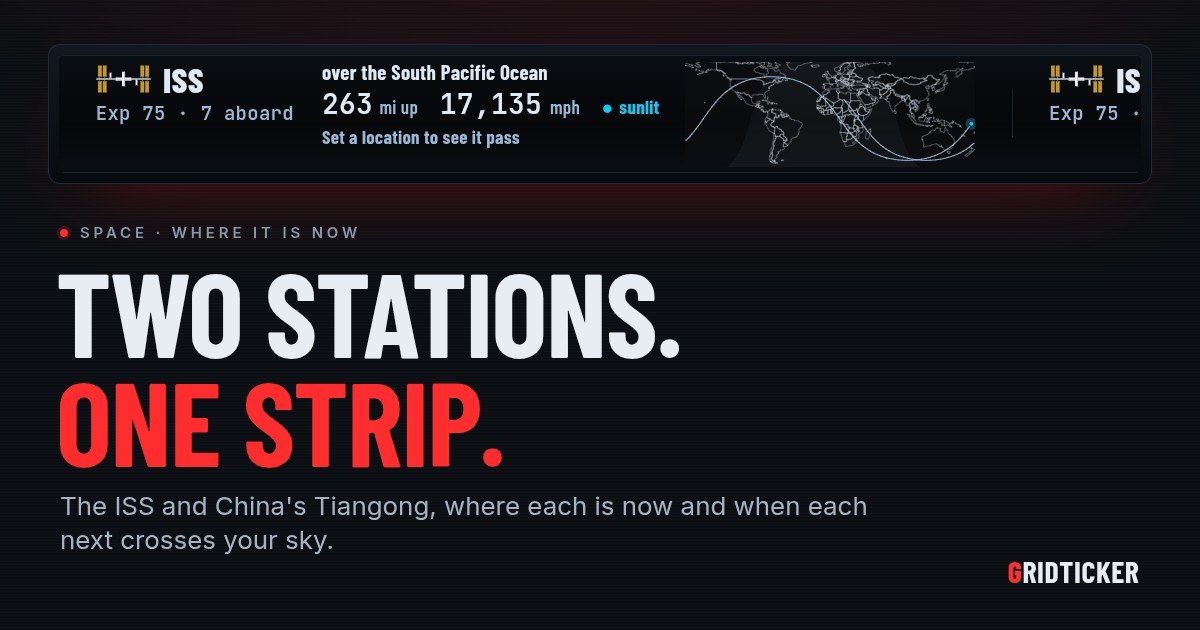
Where is the ISS right now? No page of text can tell you honestly, because the International Space Station circles the Earth about once every hour and a half. By the time you finish reading a sentence that says where it is, it has moved on. The answer to "where is the ISS right now" is always a live map, one that moves on its own and also tells you when the station will next pass over your sky. It also helps to know that the ISS isn't the only crewed station up there. China's Tiangong is in orbit too, and you can follow both of them the same way.
Why a fixed answer goes stale
The station is never parked anywhere. It travels along a path that wraps around the globe, and because the Earth turns underneath it, each lap crosses different ground than the one before. That's why most trackers draw the path as a wavy line across a flat map of the world. If you want to know how to read that line, our piece on reading the ISS ground track covers it.
So when you ask where it is, what you actually want to know is one of these:
- What it's over at this moment: an ocean, a country, a stretch of night.
- Where it's heading next: the part of the path still ahead of it.
- Whether it's in sunlight: this decides whether you could see it from the ground.
- When it next crosses your sky: the only "where" you can step outside and check for yourself.
A live tracker answers all four at once. A written answer can't answer any of them for more than a few seconds.
Two stations, not one
People who search for the ISS are often surprised to learn there's a second crewed station in orbit. Tiangong is China's space station. Its orbit is tilted less steeply than the ISS's, so it doesn't reach as far north or south of the equator. Depending on where you live, you may get a different mix of chances to see each one.
From the ground the two look alike: a steady, bright point of light moving across the sky without blinking, faster than a plane and slower than a meteor. You can see either one under the same conditions:
- The station is in sunlight, catching the Sun's light high above you.
- Your own sky is dark, which usually means an hour or two after sunset or before sunrise.
- Its path brings it high enough above your horizon to clear trees and buildings.
All three line up only in stretches. For a week or so you get passes in the evening or early morning, and then there's a gap of a week or two before the next run starts.
From "where is it" to "where do I look"
The station's position over the Earth is interesting. Its position in your sky is what you can actually use. A good tracker turns the first into the second: it tells you when the station rises, which way to face, and how high it will climb.
How high is high enough
A pass that just skims the horizon is easy to miss behind a roofline or a stand of trees. It makes sense to count only passes that climb a decent way up. A pass that reaches a third of the way to straight overhead is far easier to spot than one that peaks low in the haze.
Fists at arm's length
Heights in the sky are given in degrees, which aren't easy to picture. A handy trick is to hold your fist out at arm's length: one fist is roughly ten degrees. A pass that peaks at 40 degrees is about four fists above the horizon.
How GridTicker follows both stations
GridTicker is a live ticker that runs in a browser on a spare screen, a second monitor or a TV. It runs in "Any modern browser, on Windows, macOS, Linux or a Raspberry Pi. There is nothing to install." Its Space section includes both stations: the ISS and China's Tiangong, showing where each is and its next pass that can be seen from your place. Each station is its own feed under Space feeds, so you can turn on one, the other, or both for each screen.
The ISS card says what the station is over right now, how high and how fast it is going, whether it is in sunlight, and who is aboard. Its map shows the whole world with the night side shaded, where the station has been in the last 45 minutes, and a dashed line for where it is going next. The station moves along that line by itself, second by second, and your place is marked with a ringed dot. The bottom line of the card gives the next time the station can be seen from where you are. The guide's launches and the space station section shows what the card looks like.
Your place is set on the Space page under Where you watch the sky from. If you leave it blank, GridTicker uses your Flights location, and failing that, your first weather place.
Which passes count is your choice under The space stations: every pass above 10 degrees, or only those that clear the trees (20), a third of the way up (30), or high passes only (40). The same choice applies to the card and to the alert.
The alert is the time to step outside. For the ISS and Tiangong it starts five minutes before the station comes into view, with a countdown and which way to face. While the station is up, the screen shows a sky: the horizon drawn as a circle with straight up in its middle, the station where it is now, and how high to look, in degrees and in fists held at arm's length. You can turn each alert off on its own under Alerts. An alert shows only on a screen where its own card is switched on, and never on a screen a schedule has turned off.
If you'd like a screen that always knows where both stations are, you can set up a strip and turn on the space station feeds.