
Hockey Game Scoring: Goals, Overtime and Shootouts
Hockey game scoring is simple at the core. A team scores one goal each time the puck crosses the goal line, and the team with more goals when the game ends wins. The details come later. An NHL regular-season game is three 20-minute periods. If it is tied after that, there is five minutes of sudden-death overtime played 3-on-3. If nobody scores in overtime, a shootout decides it, and the shootout winner gets one goal added to its final score. The standings then pay out points: two for any win, one for a loss in overtime or a shootout, and none for a loss in regulation.
This week's results show every part of that. Here is how to read them.
Goals, assists and the scoreboard
Each goal counts as one, however it goes in. The player who last touched the puck gets the goal. Up to two teammates who touched it before him can get assists. A player's "points" are his goals plus his assists. That is a player stat, though. It has nothing to do with the team points in the standings.
Some goals come with a label that says what the situation was:
- Power-play goal (PPG): scored while the other team is a man short because of a penalty.
- Shorthanded goal (SHG): scored by the team that is a man down.
- Empty-net goal (ENG): scored after the other team has pulled its goalie for an extra skater, usually in the last minutes while it is trailing.
All three count the same as any other goal: one. The label only tells you how it happened.
How a regulation game ends
Most games are settled in 60 minutes. On Thursday, Boston won 6-2 at Pittsburgh, Carolina won 5-3 at the Islanders, and Vegas won 2-1 at Detroit, all in regulation. A result like that is listed simply as "Final." The winner gets two points in the standings and the loser gets none.
Overtime: 3-on-3, sudden death
If the score is level after three periods, the teams play up to five more minutes with three skaters a side instead of five. With that much open ice, overtime goals come fast, and the first goal ends the game. That goal is added to the score like any other, so an overtime result is always one goal apart.
There were plenty this week:
| Game | Result |
|---|---|
| Calgary at Seattle, Wed Nov 4 | CGY 1, SEA 2 - Final/OT |
| Utah at Montreal, Thu Nov 5 | UTA 4, MTL 5 - Final/OT |
| St. Louis at New Jersey, Thu Nov 5 | STL 4, NJ 5 - Final/OT |
| Nashville at Colorado, Thu Nov 5 | NSH 3, COL 2 - Final/OT |
In each one the winner takes two points, and the loser still gets one for reaching overtime. That extra point is why a late tying goal matters so much. It guarantees the trailing team something even if it loses.
The playoffs work differently. A postseason overtime is a full 20-minute period at 5-on-5, followed by as many more as it takes, until somebody scores. Playoff hockey has no shootout.
The shootout, and the goal it adds
If overtime ends scoreless in the regular season, each team sends shooters alone against the goalie. Each side gets three attempts, and if it is still level after that, the shootout goes to sudden-death rounds.
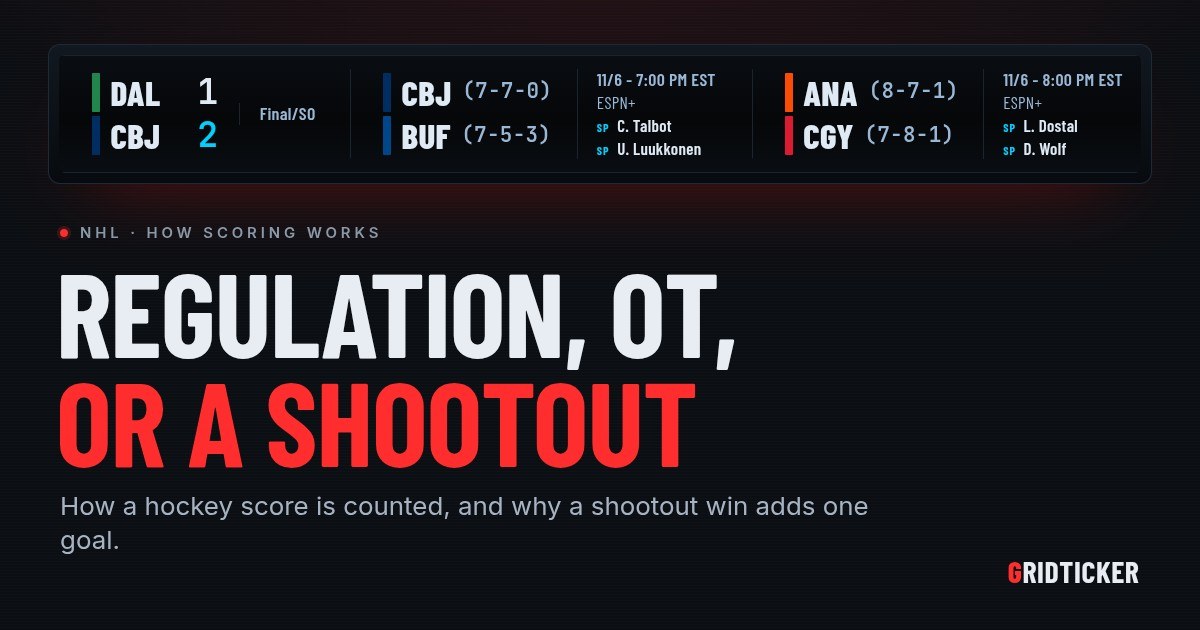
This is where the box score confuses people. The shootout goals themselves are not added up. Instead, the team that wins the shootout gets one goal added to its final score. On Thursday, Dallas at Columbus ended DAL 1, CBJ 2 - Final/SO. The game was 1-1 after regulation and overtime, and the "2" is Columbus's credit for winning the shootout. However many shots each side made in the shootout, the final score shows a one-goal margin. The goals scored in a shootout don't go into players' season goal totals, either.
In the standings, a shootout win is worth two points and a shootout loss is worth one, the same as overtime.
Reading a hockey record
An NHL record has three numbers: wins, regulation losses, and overtime/shootout losses. The Carolina Hurricanes are listed at 13-3-2 going into Saturday's home game against Chicago. That means 13 wins, 3 regulation losses and 2 losses in overtime or a shootout.
To turn a record into standings points, double the first number and add the third. For Carolina that is 13 × 2 + 2 = 28 points. A team with fewer wins can sit level with one that has more if it has collected more overtime-loss points, which is why the third number matters.
Tonight and this weekend
Here are a few games to put the scoring into practice. All times are Eastern.
| Date | Game | Time | TV |
|---|---|---|---|
| Fri Nov 6 | Columbus at Buffalo | 7:00 PM | CBJNHL, ESPN+, MSGB |
| Fri Nov 6 | San Jose at Minnesota | 8:00 PM | KSTP, MINNHL, NBC Sports BA, NHL Net |
| Fri Nov 6 | Anaheim at Calgary | 8:00 PM | ESPN+, Prime Video (Local) |
| Sat Nov 7 | Florida at Washington | 12:30 PM | ESPN+, MNMT, Scripps Sports |
| Sat Nov 7 | Montreal at Toronto | 7:00 PM | ESPN+ |
| Sat Nov 7 | Chicago at Carolina | 8:00 PM | CARNHL, CHSN, ESPN+ |
| Sun Nov 8 | Florida at Boston | 1:00 PM | NESN, NHL Net, Scripps Sports |
Columbus plays the night after its shootout win, at Buffalo, with Cam Talbot and Ukko-Pekka Luukkonen listed as the probable starters.
How GridTicker shows a hockey score
GridTicker runs in a browser on a spare screen, so you can follow all of this while it happens. On a live game, a red dot sits next to the clock and the period, and the team in front has its score lit up. Hockey rows also show each team's shots on goal. On a screen, the last play is written out, with a badge when it was a penalty or a review.
When a team scores, the goal gets its own moment for two minutes, with the scorer's name. The ticker marks the goal labels described above: it says PP GOAL, SH GOAL or EN GOAL, and on a screen it names who assisted. If you'd rather not have the celebrations, you can turn them off for each screen under How each device draws it. A finished game says Final, with /OT when it went to overtime. A game still to come shows its start time and the channel it's on. The Records switch adds each team's record next to its name on those upcoming games.
To see where your team stands, add the NHL under Standings. You get a row per division plus a wild-card table for each conference. It is off until you turn it on. Star your teams and their games lead the ticker ahead of the rest. Scores come from public sports data providers, which can run a little behind the broadcast.
If you'd like that strip on your own screen, you can set one up here.